Note
Go to the end to download the full example code.
Interpolated Tip Area Function
This example uses a tabulated contact-depth/contact-area calibration curve as an interpolated tip area function and compares it with analytical references.
import matplotlib.pyplot as plt
import numpy as np
from scipy.interpolate import interp1d

from micromechanics.indentation import Tip
Some calibrations are available as measured points rather than polynomial prefactors. Here we create such a table by perturbing the perfect Berkovich area with a shallow-depth rounding term.
calibration_depth = np.linspace(0.02, 0.8, 18)
perfect_reference = Tip("perfect")
measured_area = perfect_reference.areaFunction(calibration_depth.copy())
measured_area *= 1.0 + 0.18*np.exp(-calibration_depth/0.16)
Tip accepts an interpolation function for Ac = f(hc). The interpolation
can then be used anywhere a regular tip area function is expected.
interpolated_area = interp1d(calibration_depth, measured_area, fill_value="extrapolate")
interpolated_tip = Tip(interpFunction=interpolated_area)
spherical_tip = Tip(shape=[3.0, 70.3, "sphere"])
Compare the interpolated calibration with the perfect Berkovich and spherical references. Differences at shallow depth are especially important because small contact-depth errors strongly affect hardness.
contact_depth = np.linspace(0.02, 0.8, 120)
area_interpolated = interpolated_tip.areaFunction(contact_depth.copy())
area_perfect = perfect_reference.areaFunction(contact_depth.copy())
area_sphere = spherical_tip.areaFunction(contact_depth.copy())

fig, ax = plt.subplots()
ax.plot(calibration_depth, measured_area, "o", label="calibration points")
ax.plot(contact_depth, area_interpolated, label="interpolated tip")
ax.plot(contact_depth, area_perfect, "--", label="perfect Berkovich")
ax.plot(contact_depth, area_sphere, ":", label="spherical tip")
ax.set_xlabel(r"contact depth [$\mathrm{\mu m}$]")
ax.set_ylabel(r"projected contact area [$\mathrm{\mu m^2}$]")
ax.legend()
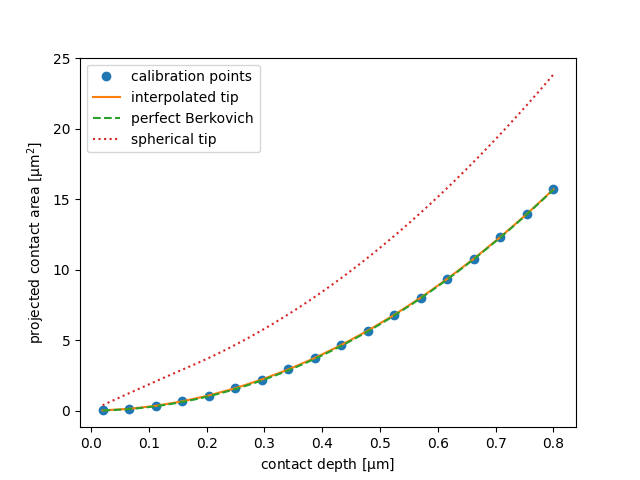
<matplotlib.legend.Legend object at 0x7ff2ef110a50>
The representation confirms that this tip is driven by an interpolation function instead of polynomial prefactors.
print(interpolated_tip)
compliance: 0.0; with interpolation function with 18 points
Total running time of the script: (0 minutes 0.082 seconds)