Comparison with orix and MTEX
orix is a Python library for crystal orientation analysis;
MTEX for Python (pip install mtex) is the Python version of the MATLAB
texture toolbox. This page compares orix 0.15.0 and MTEX for Python 1.0.0 with ebsdlab.
Features
ebsdlab |
orix |
MTEX for Python |
|
|---|---|---|---|
file formats |
|
|
|
hexagonal scan grids |
load, maps and neighbor analysis |
load only, no maps |
load, maps and neighbor analysis |
crystal symmetry |
Laue groups of the seven crystal systems |
all 32 point groups, space groups via diffpy.structure |
all 32 point groups |
maps |
IPF, CI, IQ and other scalar maps, unit-cell overlays, scale bars |
IPF and property maps |
IPF and property maps, many color keys |
pole figures and texture |
pole figures with the pole density in multiples of random (mrd) |
pole figures and pole density functions |
pole figures, ODFs from EBSD and from pole-figure data, texture characteristics |
KAM and grains |
KAM, grain reconstruction, grain dilation |
– |
KAM, grains and grain boundaries, denoising, parent grain reconstruction |
graphical user interface |
|
– |
import wizard that writes the import script |
speed and memory |
see Resource usage |
see Resource usage |
see Resource usage |
installed packages |
12 (see Dependencies) |
41 |
4, or 16 with the numba, plot and io extras |
ebsdlab: large maps on little memory, hexagonal scans and quick looks.
orix: a rich data model (quaternions, rotations, orientations, misorientations), all point and space groups.
MTEX for Python: the widest analysis (grains, boundaries, ODFs, parent grains), with the syntax of MATLAB MTEX.
Resource usage
Each package loads an .ang file with 1.6 million points and plots its IPF map along Z.
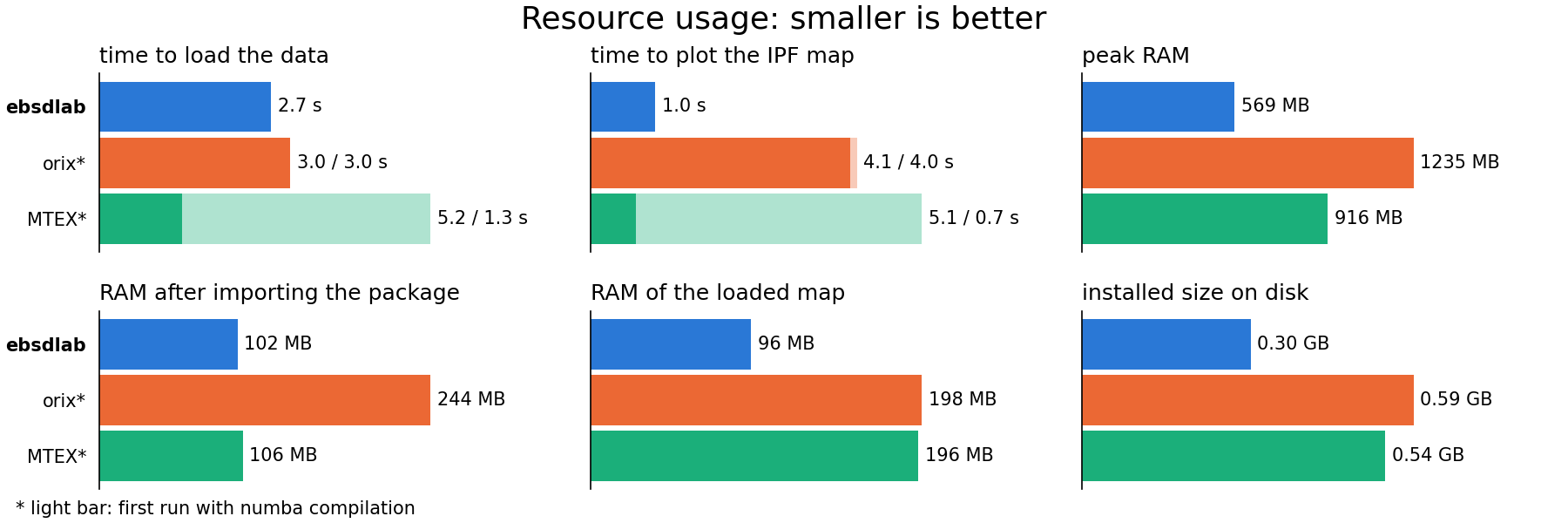
Once numba has compiled, MTEX is the fastest; on the first run after an installation, the compilation makes it the
slowest. ebsdlab needs no compilation, the least RAM (half of orix, 60 % of MTEX) and the least disk space: it stores the
map as float16 and folds each pole directly into the standard triangle.
Details: measured on 2026-10-21 with ebsdlab 1.0, orix 0.15.0 and MTEX for Python 1.0.0 (mtex[numba,plot,io]),
Python 3.14.4, numpy 2.5.4, scipy 1.18.1 and matplotlib 3.11.2, on a laptop (AMD Ryzen 5 3500U, 14 GB). Each package
has its own virtual environment and each measurement its own process; the first run starts from an empty numba
cache, and three repetitions agree within 0.2 s. orix and MTEX use the TSL color key. Peak RAM includes the imports;
the RAM of the loaded map is the size of all its arrays. The file is EBSD_deformed_I_ED.ang of Maj et al. (Zenodo
18668585, 190 MB). orix cannot plot hexagonal grids, so every second row is shifted by half a step to make the grid
rectangular; on the original hexagonal file, ebsdlab and MTEX are as fast.
Dependencies
package |
direct dependencies |
total installed |
|---|---|---|
ebsdlab |
3 (numpy, scipy, matplotlib) |
12 |
ebsdlab[gui] |
4 (adds PySide6) |
16 |
orix 0.15.0 |
11 |
41 |
mtex 1.0.0 |
3 (numpy, scipy, finufft) |
4 |
mtex[numba,plot,io] 1.0.0 |
6 (numpy, scipy, finufft; extras numba, matplotlib, h5py) |
16 |